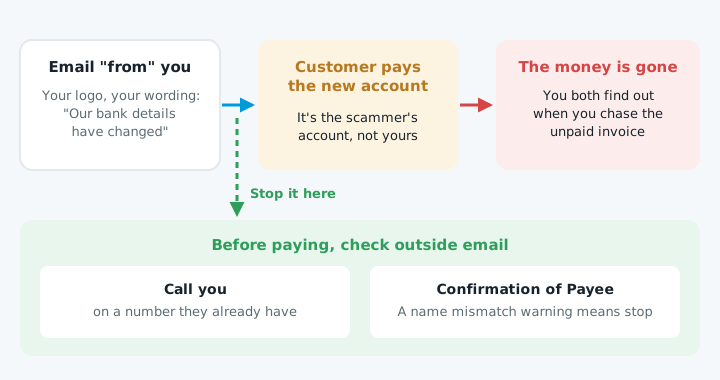
A fake invoice scam is an email that looks like it's from you, saying your bank details have changed. Your customer pays the new account and the money is gone. Three fixes close most of the gaps: DMARC on your domain, a locked-down mailbox, and a habit of checking bank changes by phone.
In a BNZ survey of 483 small businesses in September 2025, one in ten had run into invoice scams involving changed bank details.
How scammers send email "from" you
| Method | How it works | Fix |
|---|---|---|
| Spoofing your exact address | Email lets anyone type any "From" address | DMARC |
| A lookalike domain | They register something close, like yourbusinesss.co.nz |
Checking by phone |
| Your real mailbox | They get your password and reply from your account, often hiding replies with a rule | Two-factor sign-in |
Stop spoofing with DMARC
SPF and DKIM let receiving servers check an email really came from you. DMARC set to quarantine or reject tells them to junk or block email that fails. It catches fakes of your exact domain, not lookalikes or a hacked mailbox. See DMARC explained and how to add an SPF record.
Lock down your mailbox
- Switch on two-factor sign-in for everyone's email.
- Check for forwarding and inbox rules you didn't make. Scammers use them to hide your customers' replies.
- Use a password for email that you don't use anywhere else.
Make changed bank details hard to fall for
- Say it on every invoice. "Our bank details will never change by email. If you get a message saying they have, call us." Give a number they already have.
- Put your bank details on your website, so customers can check before they pay.
- Mention Confirmation of Payee. NZ's main banks check whether the account name matches the number before a payment goes through. A mismatch warning is a reason to stop and ring you.
If it's already happened
Move fast. Banks can sometimes stop or recover a payment if they hear quickly.
- Ring your bank straight away, and ask your customer to ring theirs.
- Change your email password, sign out every session and check for forwarding rules.
- Report it to the National Cyber Security Centre.
- Warn your customers by phone or text, not from the email account that may be compromised.
When to get help
If your domain has no DMARC record, or you think someone has been in your mailbox, get it looked at now rather than after the next fake invoice. Start with our free website check.