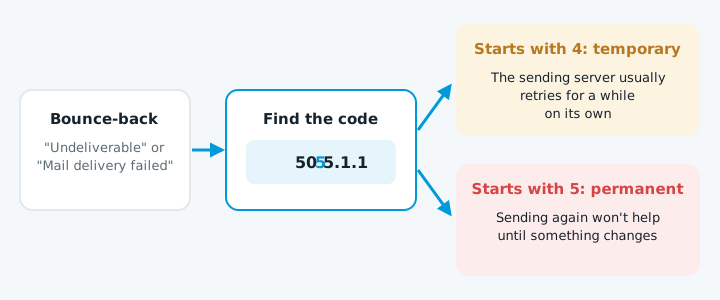
A bounce-back ("Undeliverable", "Delivery Status Notification (Failure)" or "Mail delivery failed") contains a code that tells you what went wrong. Find the code, then use the table below.
Find the code
Look for a three-digit number followed by something like 5.1.1:
550 5.1.1 The email account that you tried to reach does not exist.
Codes starting with 5 are permanent. Sending again won't help until something changes. Codes starting with 4 are temporary, and the sending server usually retries on its own.
The common codes
| Code | What it means | What to do |
|---|---|---|
550 5.1.1 |
The address doesn't exist | Check for a typo, or ask for their current address |
552 5.2.2 |
Their mailbox is full | Try later, or contact them another way |
550 5.7.1 |
Rejected by their server's rules | Often your SPF, DKIM or DMARC, or a blacklist |
550 5.7.26 (Gmail) |
Failed Gmail's authentication checks | Fix SPF, DKIM and DMARC on your domain |
550 5.7.515 (Outlook) |
Doesn't meet Microsoft's authentication requirements | Fix SPF, DKIM and DMARC on your domain |
554 5.7.1 with "blocked", "blacklist" or "reputation" |
Your server or domain is on a blocklist | Find which list, fix the cause, then request removal |
421 4.7.0 |
Temporarily deferred | Usually clears. If it keeps happening, check your authentication |
If many emails bounce at once
A sudden wave of bounces mentioning authentication or blacklists usually means one of two things. Either your domain's email settings are missing or broken (see why emails go to spam and how to add an SPF record), or your mailbox has been sending spam. In that case:
- Change your password now.
- Switch on two-factor sign-in.
- Check for forwarding rules you didn't create.
Bounces for emails you never sent
Someone is sending spam that pretends to come from your domain, and the bounces come back to you. A DMARC record set to quarantine or reject tells other servers to junk or block fakes of your exact domain.
When to get help
A single bounce from a typo or a full mailbox is easy to sort. If lots of email is bouncing, or the codes point to authentication or a blacklist, hand it over before it costs you jobs. Start with our free website check.